June 16, 2015

G-7 and Barkcloth - a great combination!

It is about time I posted some great updates on bark cloth! So many things are in the works that I have yet to get all the details from Uganda to write a proper post.

But for now, this came across my email from Mary and Oliver Heintz, proprietors of the European/Ugandan based company Bark Cloth_Europe, www.barktex.com.

It seems that the meeting of some of the most powerful women and men in the world happened in a room filled with bark cloth. This work was personally installed by Oliver and Mary in Castle Elmau in Germany for use as acoustic panels to absorb sound - I see the reason now!


This is excellent to see and we continue to hope that bark cloth reaches more places throughout the world!!! For more amazing objects made with bark cloth through Bark Cloth_Europe, see http://tradephoto.eu/show/2014/01IMM/BarkCloth/.

*Two similar panels of their black and gold thread bark cloth panels were on display during Material Evolution: Ugandan Bark Cloth at UNT in 2011. They are now in the UNT permanent collection.

June 2, 2014

Ugandan Bark Cloth included at the National Gallery of Art in China exhibition on intangible cultural heritages!


Third International Photography Biennial in the National Art Gallery in Beijing, exhibition
"The Intangible Cultural Heritage"

I was asked by Diana Kingsbury of Chinese Photography Magazine to submit photographs of Ugandan Bark Cloth making for this exhibition on cultural heritages. I was very excited to share my images of a co-op of bark cloth makers from the Rakai District that I shot in 2008. As a disclaimer, I was unable to supply the names of the specific makers, unfortunately my notes were of no use.

Here is the translated text for those interested:
Barkcloth making is an ancient craft practiced by the Baganda people in southern Uganda. Craftsmen of the Ngonge clan, headed by a hereditary chief craftsman, traditionally made bark cloth for the Baganda royal family and the rest of the community, employing a prehistoric technique that predates the invention of weaving. The inner bark of the Mutuba tree (Ficus natalensis) is harvested during the wet season and, through a long and strenuous process, beaten with wooden mallets to a soft and fine texture of even terracotta colour. Craftsmen work in an open shed to protect the bark from drying out too quickly. Traditionally, barkcloth is used at coronation and healing ceremonies, funerals and cultural gatherings; it also served very functional purposes, including curtains, mosquito screens, bedding and storage. In recent decades, this cloth has been used by artists and designers in Uganda and abroad for high fashion, fine art, and inventively designed products.

Image captions:
All photos courtesy of Lesli Robertson
1.The bark cloth co-op, Bakomazi Agali Awamu Twesitule, of Mananma, Rakai District, Uganda, 2008
A co-op member stripping the bark from the mutuba tree. This process does not kill the tree, with proper care the bark can be harvested once a year for 30-35 years.
2.The bark cloth co-op, Bakomazi Agali Awamu Twesitule, of Mananma, Rakai District, Uganda, 2008
A co-op member using a grooved wooden mallet to pound the bark into cloth. This process takes from 2 - 4 hours and will result in the barkcloth reaching over 4 times it original width.
3.The bark cloth co-op, Bakomazi Agali Awamu Twesitule, of Mananma, Rakai District, Uganda, 2008
The co-op members discussing the cloth that was just finished. To complete the process, the barkcloth is stretched on the ground and held in place by large stones. The sun dries the cloth and enriches its natural rust color.
4.The bark cloth co-op, Bakomazi Agali Awamu Twesitule, of Mananma, Rakai District, Uganda, 2008
This finished piece of bark cloth is a beautiful example of the quality that can be achieved through the process. What began as bark is now a supple cloth.

March 17, 2014

Small Shoes, Big Idea.

I recently posted on an artist, Bobby Britnell, and her interest and work with Ugandan bark cloth. I gave you all a hint as to an upcoming project of hers with collaborator, Janet Middelton, a shoe designer in the UK with Star Child Shoes.

These two amazing artists are rethinking how to support their efforts to promote Ugandan bark cloth and the communities it can change - through a project called Barkcloth to Artcloth. Check out the link.

"The exquisitely stitched and beautifully embellished barkcloth contributions, from well over 100 people, and all made up by Janet Middleton into fabulous baby shoes, fits perfectly with this strap line, ONE TINY STEP TO A BRIGHTER FUTURE . This is because they have all been made in support of 'Hands up for Uganda' and building awareness of this charity in such a creative way, will lead to brighter futures for so many children and all community members of Kisaabwa." Bobby Britnell.

Each pair of shoes is made from a piece of barkcloth that has been transformed by artists from all over the world. They will be exhibited at the following venues in England with more to follow!

Creative Stitches, NEC Birmingham          20th to 23rd March 2014   
Creative Stitches, EXCEL London            3rd to 5th April 2014


Since I began researching barkcloth in 2005, I was always asked if I ever used it in my artwork, and the answer was always no. I think that from the first time I spied it in Wakiso in a small stall, I never felt like a participant, but an observer. Even after learning about the incredible opportunities to manipulate the surface, transform the material into 2 and 3 dimensional objects, I did not incorporate it into my studio practice. Until....
Bobby asked that I and a fellow artist, Amie Adelman, participate in Barkcloth to Artcloth, and I have fallen in love with the material in a new way. It was wonderful to hold the material and think about how I wanted to leave my mark on it. I don't foresee a new body of work as of yet, but it was great to find a new way to relate to the material. Here are images of my cloth and Jane Middleton made shoes!


September 19, 2013

A new project out of the UK

I recently had the wonderful chance to meet through Skype, Bobby Britnell, a textile artist from Shropshire  in the United Kingdom. A quick look at her website shows her interest in textiles revolves around creating beautiful surfaces in her own work while opening her home for students to take workshops on the art of embroidery and stitch.
New Lines of EnquiryNew Lines of Enquiry, 2008

So how does this fit into my blog on bark cloth.....

Bobby has taken her interest in textiles with her as she travels to and works in Uganda. She  and her husband work with the local community to run a small organization in the town of Kisaabwa, Hands up for Uganda, focusing on the traditional crafts of basketry and woven mats. As a textile artist herself, Bobby is passionate about engaging with the women in Kisaabwa and learning about their materials and crafts.

Bark Cloth which grows readily in this part of Uganda is being used as part of an exciting collaborative project between 'Hands up for Uganda', Bobby Britnell and Janet Middleton from Star-Child Shoes.
Surfaces on bark cloth
 
"We aim to engage textiles artists from the UK and further afield in its conception. We require artists to decorate and embellish a piece of bark cloth in any way that they like and these pieces will be made up into 'ART SHOES' by Janet as a part of two exhibitions in 2014, in Birmingham and London. This exhibition will not only exhibit dozens of 'Art Shoes' but also the craftwork from the women of Kisaabwa."

Amie Adelman and I will both be a part of this project - so more updates will follow!

As a wonderful side note -  on the organization's farm in Kisaabwa ,100 Mutuba trees have been planted!

August 6, 2013

Bark Cloth a part of the LAUNCH Challenge!!!

 
NASA, USAID, Department of State, and NIKE joined together to form LAUNCH in an effort to identify, showcase and support innovative approaches to sustainability challenges.

They have a competition for the Top 10 LAUNCH Innovations AND bark cloth is a part of the challenge!

Mary Barongo and her partner Oliver Heintz submitted their work with manipulating and innovating with this material through  BARKTEX® agro-forestry tree bark textiles & composites.

French shoe designer Mats Rombaut, UNT professor Dr. Nandika D'Souza, myself, and others have joined the team to support promoting the potential applications of bark cloth to new audiences through this award.

TO VOTE: simply log in to www.launch.org and follow the links!

THANKS!

July 9, 2013

A new book on Bark Cloth published


Dr. Celia Nyamweru, a fellow bark cloth enthusiast, worked with Dr. Catherine Gombe to publish Barkcloth in Uganda: The modern day importance of an indigenous craft. 

Here is a short excerpt:

The Baganda people of southern Uganda have been making cloth from tree bark for several centuries. Until the mid nineteenth century barkcloth was made in almost every Baganda homestead and had a wide variety of uses, ranging from the practical to the ritual and ceremonial. Political and economic events since then have brought about profound social and cultural changes, with resulting impacts on the role of barkcloth in Baganda society. While many of its more practical functions have been taken over by imported or artificial materials, its ceremonial role has survived, and new uses have multiplied. Barkcloth is now used to make artistic creations and craft pieces that are sold far beyond the borders of Uganda. In this book we describe the way in which raw tree bark is converted into the finished cloth. We look at the process, the product and the people involved in this industry. We describe the artists and craftspeople who make barkcloth items such as table mats, purses, wall hangings, lamp shades and articles of clothing. We look to the future of this product and the challenges faced by an indigenous craft in an increasingly globalized world. 


African Textiles a Hit on European Catwalks


This is a great article by Michael Scaturro, highlighting UGANDAN BARK CLOTH. It features a short interview with Mary Barongo from the German company, Bark Cloth Uganda.  
So glad that Voices of America highlighted this great material. 
I pulled a few photos and quotes from the article - so click on the link below to read it in its entirety.

African Textiles


June 27, 2012

Olubugo Reloaded: The Push Towards a New Awareness

The Start Journal of Arts and Culture is an online publication based out of Uganda. The editor, Thomas Bjornskau and his team of talented Ugandan artists, highlight the ever evolving arts scene throughout Uganda and East Africa. Each month brings a glimpse into the engaging and powerful works created by dancers, visual artists, musicians, writers, and more. In the April edition, I wrote about an exhibition at FAS FAS Gallery titled Olubugo Reloaded. Take a look at the link below the hear my interview with Ronex Ahimbisbwe, the exhibition organizer.

http://startjournal.org/2012/03/olubugo-reloaded-the-push-towards-a-new-awareness/

January 26, 2012

Something interesting with bark....


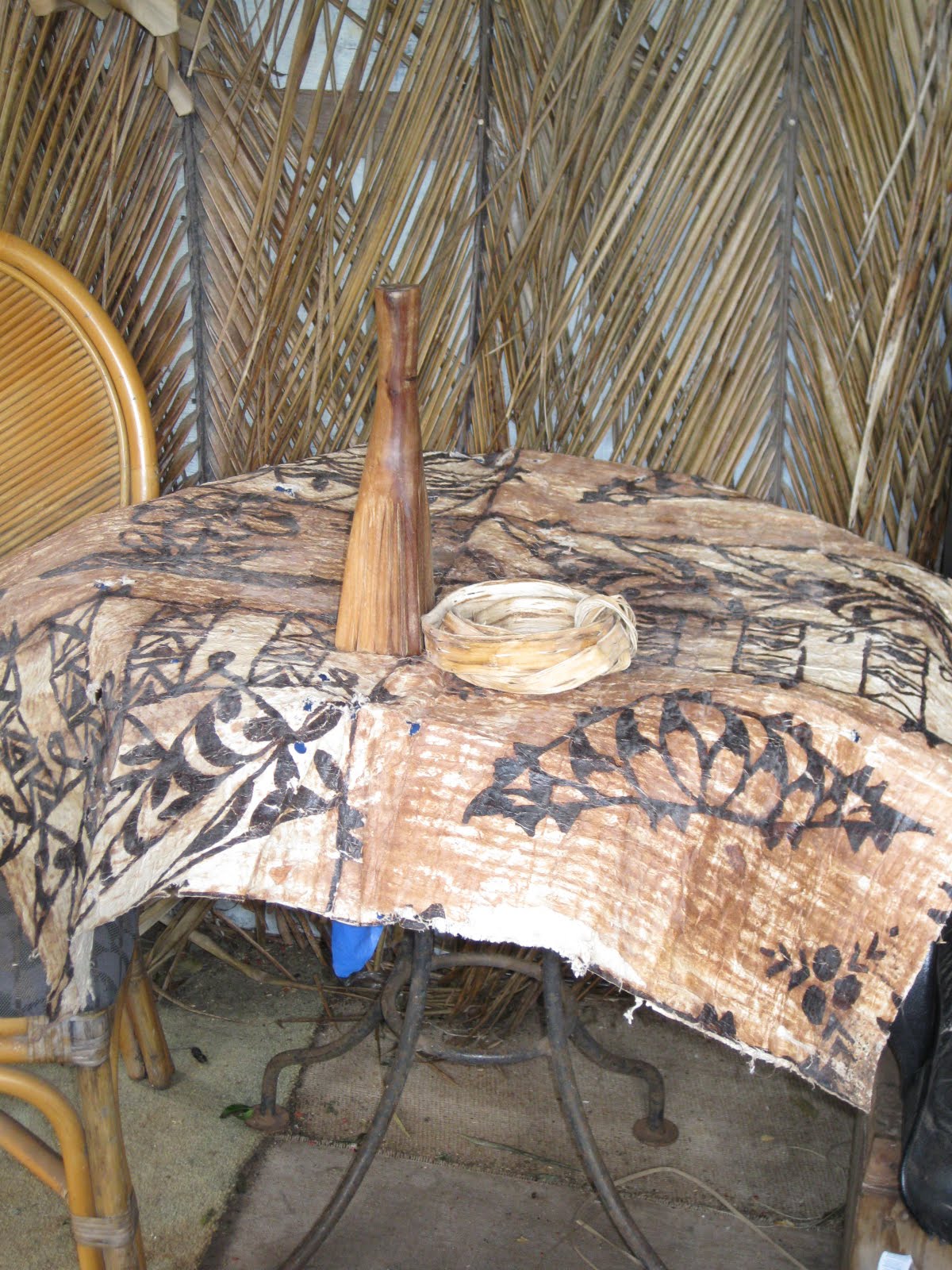
A sister (or brother) to Ugandan bark cloth is tapa, produced from mulberry trees all along the equator. I was recently visiting Hawaii and found an opportunity to learn a bit more about the cloth and see the technique and elements used to make the tapa. North, along the Kamehameha Highway near the Kalewa Bay Beach Park is a small road side market that sells arts and crafts from Tonga. The proprietor was a generous woman who allowed me to see the trees, the tools and shared her knowledge with me. This bark cloth from Tonga is routinely decorated with sharp decorated shapes, repetitive and geometric.
After leaving this market, we drove along the highway to the Polynesian Cultural Center. There, we found a display of traditional objects from Hawaii and surrounding Polynesian islands, including Tonga. The tapa that was displayed was of exceptional quality and reflected the excellence found in this craft.

October 26, 2011

ExhibitsUSA to tour bark cloth exhibition!


I am excited to announce that ExhibitsUSA, a program of the Mid-America Arts Alliance out of Kansas City, has accepted Material Evolution: Ugandan Bark Cloth as one of their touring exhibitions! This is an incredible opportunity to share this work and this unique material with audiences throughout the United States.

See the exhibition link at - http://www.eusa.org/exhibit/BarkCloth/description

If you are aware of a venue that would be interested in hosting the exhibition, please contact moreart@maaa.org.

April 22, 2011

Exhibition artists


Sara KatebalirweSara Katebalirwe is owner and lead designer of Marie-Sar Agencies Limited based in Kampala, Uganda. She began her design career as a self-taught garment designer after a brief career in social administration. After an opportunity at the United Nations Textile Development Agency (TEXDA), she became engaged with product development; a new direction for her work which previously focused on one of a kind and specialty made garments. Sara has continued to develop designs using bark cloth and raffia, sometimes in collaboration with Sarah Nakisanze of Uganda and Rene Malcorps of Art Nature and Design in the Netherlands. Sara been recognized for her innovative designs, including: the nomination for the ‘Pan-African Women Invent and Innovate Award’ (Ghana 2005), receiving the ‘Achievers Award (2005)’ from Uganda Women Entrepreneurs Association Limited, the prestigious ‘Canada Gift and Table Association’s Top 10 Product Winners 2007’ Award and the Uganda Women Entrepreneurs Association’s ‘C. Busuulwa Pioneer Award’ for her work with bark cloth. Most recently she was a finalist in the Cartier Women’s Initiative Award in Paris in 2010.


Ivan Yakuze A graduate from Makerere University with a Bachelor of Industrial and Fine Arts degree in 2001, Ivan Yakuze was able to train under professors who encourage experimentation with mixed media design. Conversations surrounding the role and importance of bark cloth to the cultural heritage of Uganda were a part of the environment in which he worked and learned. His work has developed out of a strong sense of design; creating intuitively, finding freedom in a mixed media approach to material relationship. His relationship to the material he uses comes from his belief that everything has a purpose and function; it can be recycled into a new life.

Ivan continues to explore the potential for bark cloth in the creation of works that have found their way into collections in the United States and Uganda. He has worked with Fred Mutebi, of Let Art Talk, in a variety of education outreach opportunities that brings art to the communities in rural areas of Uganda.


Renè Malcorps, Art Nature Design and Kingskin DesignsRenè Malcorps, is owner and head designer at the company, Art Nature Design, based in Eindhoven, Netherlands. Early in his career as an artist and graphic designer, he focused on exploring the role of nature in his work. This interest eventually led him to pursue a Master’s in Sustainable Design at the Design Academy Eindhoven. During his studies, he discovered bark cloth and eventually formed Art Nature Design, creating bark cloth products under the brand Kingskin; selling special and sustainable products made of natural materials from Uganda. His focus on the relationship of the environment to sustainable product design has led Renè to pursue projects that benefit the local economy and environment in Uganda, including a future partnership with the Jane Goodall Institute. In addition to designing for and running his business, he is currently teaching In and Outdoor Design at the The Green Campus in Helmond. Renè has won several awards including the international BID Challenge Award in 2006 and the Small Business Innovation Research Programma award for Biodiversity in 2009.

Emily Brewer, Decode DesignsEmily Brewer is a UK based designer who has been working with bark cloth for close to four years to create sustainable interior textile objects. She found that bark cloth allowed her to reconcile her designs with a desire to minimize the environmental impact of non-renewable materials. Through her company, Decode Designs, she explores the potential of this material in 3-dimensional design, sculpting it into patterned structures that respond to the unique color and tactility of each piece of bark cloth. She creates wall coverings, lamps, wall panels and more; her work can be found in private collections in the UK and United States. Her focus on using sustainable materials has taken her to exhibitions and fairs in Europe and the United States, including Maison et Object in Paris and Ecobuild in London. As she continues to work with bark cloth, she has “developed a certain respect for it and for what, after all, was once a living plant.”

April 1, 2011

The Exhibition - Material Evolution: Ugandan Bark Cloth

There were so many wonderful artists and designers involved in the exhibition that I wanted to give you an idea of who they are and what they do. So in two postings, you will see an image of the piece and a bio on their work.
Here are the bios, in no particular order, from the exhibition artists and designers.
All photos courtesy of University of North Texas Art Gallery; photography by Matt Golden. All images copyrighted.


Gloria Wavamunno is a London trained and Uganda based fashion designer. Her label GloRia WavaMunno was launched in 2009 at Africa Fashion Week in Johannesburg, South Africa. Her blend of printed kitenge fabrics with silks, cottons and other fabrics has brought praise for her designs. Recently, her design was featured on the cover of Arise Magazine in July 2009 and she was awarded the Overall Designer of the Year at the Afrikan Fashion Awards in 2010. Gloria’s work can be also found off the runways as a video stylist for several Ugandan musicians including Navio and Mys Natty.

Susana Duarte-Pinto Susan Pinto’s fashion design label Losgeloest is based in Frieburg, Germany. Her work is an exploration of texture, manipulating sustainable materials to create innovative surfaces. She was introduced to bark cloth through Oliver Heintz at Bark Cloth Europe five years ago. She is able to transform bark cloth into a soft, wearable garment, exploring various surface techniques including felting and dyeing. Her work has been recognized for its innovation, including the ISPO BrandNew award.


Peter BoehmPeter Boehm considers himself a carpenter first and foremost. In 2000, he formed his company, Inform, specializing in custom designed furniture, cabinetry and more. His interest in art, architecture and design influences his work, while a sensibility for materials is explored through his furniture line, KUHLT, started in 2010. An interest in new materials brought him to explore bark cloth as a new addition to the KUHLT line. His work is found in private residences throughout Germany and Luxemborg.


Markus WernerSince his childhood, German designer Markus Werner wanted to make shoes. His first pair was created at age 10, out of clay. This passion was put on hold; after graduation in Integrated Product Design at the University of Applied Sciences in Coburg in 2006, he moved to Estonia to support a design office there. He returned to Germany to hold an internship at a small factory for safety and professional shoes. This experience enabled him to learn how to make shoes from the scratch while working as a shoe developer for the last two years. In 2010 he started his project Vimagana (Norwegian for “we want to go now”), creating shoes that combine ecological materials with unique design elements. Starting from usual shoe manufacturing processes and materials, his aim is to replace traditional materials with more exciting non-polluting materials like Ugandan bark cloth.


Oliver Heintz and Mary Barongo Heintz of Bark Cloth EuropeFor 10 years, Oliver Heintz along with his wife and business partner, Mary Barongo, has been exploring the potential of Ugandan bark cloth to serve as a new material for artists and designers worldwide. He formed the company BARK CLOTH® Europe, with offices and workshops in Uganda and Germany where they continue to push the limits of this natural material by dyeing, gilding, rubberizing, bleaching, and more. They have won numerous design awards throughout Europe, including the Innovation Award BioMaterial of the Year and the Materialica Design + Technology Award; they are nominated for the 2011 Design Award of The Federal Republic of Germany. Through their promotion of bark cloth, they have worked with numerous designers and companies to explore concept works that test the potential of bark cloth in product design and artwork. As seen in this exhibition, they have worked with companies like Mercedes Benz to explore the use of bark cloth in car interiors. They combined bark cloth and felt to create functional furniture in collaboration with Jakob Lang. Through the initial design work by Mary, women in Uganda were taught to create innovative designs by stitching bark cloth panels for the wall covering by ARTE International of Belgium.


Sarah NakisanzeKampala based designer and lecturer, Sarah Nakisanze began creating at an early age through the influence of her mother who was a teacher and dressmaker. As an undergraduate student at Makerere University, she studied painting and drawing. A catalyst for her interest in textiles and culturally relevant materials came in the mid-90s as she was working in a Kampala based art gallery. She became familiar with Kuba cloths from Congo; their strong cultural attachments and distinctive materials led Sarah to push for a similar reflection of Uganda in the work she was creating. In 1999, Makerere University hosted a printing workshop in which Sarah began experimenting on bark cloth; she discovered that it held many possibilities as an art medium. In 2000, Sarah was selected to participate in a training project sponsored by the United Nations Textile Development Agency (TEXDA). In addition to winning several TEXDA design awards, through this program, she acquired business training that gave her the skills to develop her pursuits as an artist into a successful career. Sarah is currently Assistant Lecture at the Makerere University Margaret Trowell School of Industrial and Fine Arts. She also runs her design business, Easy Afric Designs where her work is shown in local venues as well as through several international fair trade organizations. She has exhibited internationally, including shows in the UK and United States.

March 5, 2011

Material Evolution: Ugandan Bark Cloth


This is just a preview of the exhibition and activities from this past week. An open studio, workshop, lecture, storytelling event, and of course the opening made it an exciting and memorable time for all of us involved. I am still gathering photos from all the events and hope to begin posting them in the next week!
If you are in the Dallas/Fort Worth area, please come by to see the exhibit, it is only open until the 26th!
All photos courtesy of the University of North Texas Art Gallery; photography by Matt Golden.

February 4, 2011

Talking Mural exchange that began in Kibinge.....


A few weeks ago, I had the privilege of attending the completion of the Renewing Material: Nurturing Environment mural at Rasor Elementary School. Led by project assistants Rebecca Schaefer (art Teacher at Rasor) and Amanda Batson (UT Austin), a select group of students from each grade were invited to add their vocabulary about the environment to the mural that was began in Kibinge, Uganda.
The focus of this exchange was to give an opportunity for students to think about their role in a global village. To think about the lives of students on the other side of the globe and how they are linked by caring for our one world.
One very special part of the day was the video conference with Fred Mutebi in Uganda. This was incredible opportunity for the students to ask Fred about Uganda, what they eat, what the environment looks like and even what is happening to the environment. Fred's energy and enthusiasm encouraged each student to learn more.
The mural will be exhibited at the University of North Texas as a part of the Material Evolution: Ugandan Bark Cloth exhibition opening on March 1st at the UNT Art Gallery.
Here are a few photos of the mural as it came to be.

From Kasota Primary School in Uganda


From Rasor Elementary in Plano, Texas

January 13, 2011

Connections made...highlighting Kinderen van Uganda

Since 1995 Kinderen van Uganda, under the leadership of Ruud Boon, has supported a varity of projects in Uganda. Since 2000, Fred has worked with KvU in Uganda and giving workshops on printmaking in Holland. It was through their connection that Project Kibinge started. With the support of a Dutch fund they are building the Community House in Bugoga, Kibinge. They are in the process of raising support for finishing the roof; once this building is complete it will serve as the centre of activities for the communities of Kibinge.

KvU was a supporter of the Renewing Material project, their groundwork in the Kibinge area and the use of the community building site allowed us to join together as we promote the preservation of bark cloth. Their continued investment in the area will build from what we did by continuing the conversation surrounding bark cloth. They are able to go a step further; they continue to support tree planting efforts, are investigating new markets for Bark Cloth/Lubugo in Europe and will be investigating the possibilities of carbon rights which could make it possible to invest in child-projects in Kibinge and other areas in Uganda.

Here is an excerpt from a recent email from Ruud - "In Uganda we are supporting a shelter for streetchildren in Kampala,school sponsoring vocational secondary education, a primary school near Jinja and the mother and child care program in Mukono. Kibinge is the other and important part of our work.In this project Kibinge we work together with the municipality of Deventer, the city we are living. It is great that this municipality wants to support the project and the local council of Masaka in improving policies for childcare, education and rural development. The most important thing in Kibinge is to help the communities in making their own plans for the future.We want to support this with ideas, attention and some funds. During my last visit I met the local people of Kibinge and i am very sure these communities want to make a better future for the families and children.
They earn our support!"


For more info, see www.kinderenvanuganda.nl

I have included photos of the Kibinge community center in progress as well as a group of students from the local teachers college participating in a Talking Mural led by Fred Mutebi. This is being painted on the community center, facing the road.

December 11, 2010

The First Week...odds and ends


A good friend of Fred's and someone who I have enjoyed getting to know over the years is Rose Mwanja, chief conservator from the Uganda Museum. She has been so gracious to me as I have been researching plaited mat making and bark cloth. During my trip in 2008, she was one of the scholars who was interviewed for the Material Evolution exhibition. We barely made it through the interview for laughing so much. I am very thankful for her support. She was to make it to the exhibition in Masaka but had an emergency at the museum the morning of - we missed having her there! That is Fred seated to her right.


During my trip, someone asked me who Fred Mutebi was and what he did. I tried to explain about his artwork, his work with children and the community, but it was becoming too lengthy - so I just said that he is an artist activist. I feel that is a good title for an artist who is so concerned about the trials of his country that he works hard using what he knows, art, to brings about conversation and provoke people to think about issues. I say all of this to introduce a project that I was able to see Fred work on with secondary school students at the Lubiri Secondary School. In February, elections will be coming and with that the potential for violence. Fred worked with an organization called Fair Pen (www.fairpen.com) to organize the creation of a Talking Mural with the theme of "Together we can talk to avoid electoral violence."
Fred continued this message as he worked with the Lubiri students to create prints using a reductive method. I had the opportunity to attend and talk with some of the students. I am including some images from that workshop.